
Table of Contents
- Why Optometry Groups Need More Than Basic Message Taking
- What an Answering Service for Optometrists Should Handle
- Compliance and Risk Considerations
- Centralized vs. Location-Level Call Handling
- How to Evaluate Vendors
- Implementation Plan for Multi-Location Optometry Groups
- What Buying Committees Should Ask Before Signing
- Where MyBCAT Fits
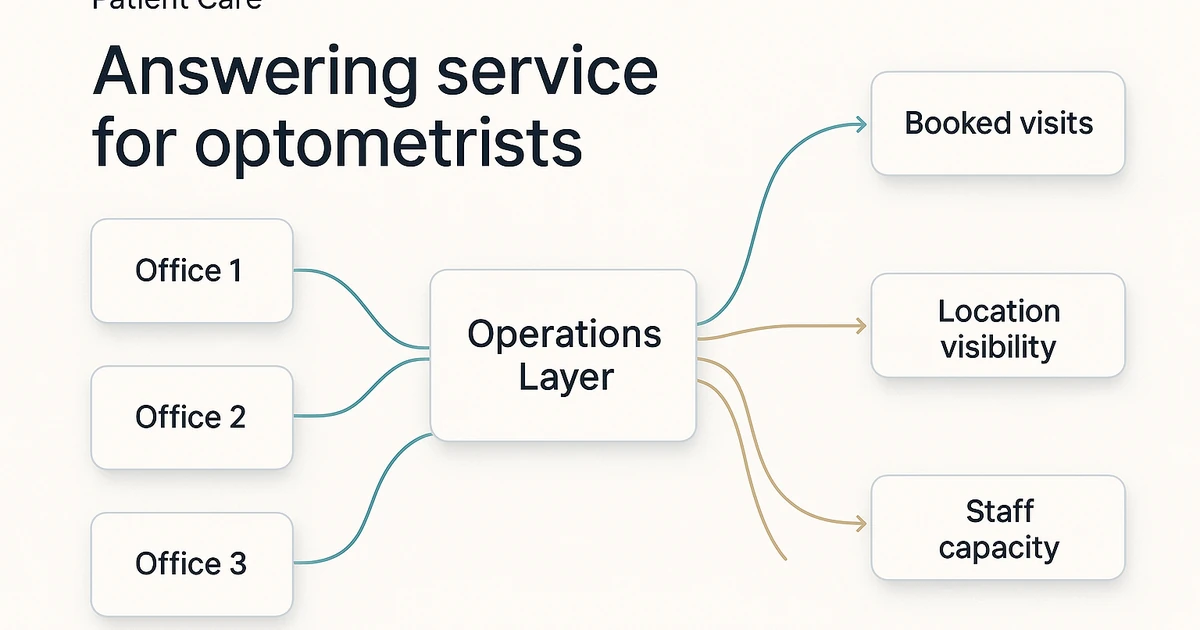
An answering service for optometrists is not just overflow phone coverage. For a multi-location eye care group, it becomes part of the patient access system: how patients reach the practice, how calls are routed, how appointments are scheduled, how urgent concerns are escalated, and how each location delivers a consistent front-office experience.
That distinction matters for COOs, VPs of Operations, and buying committees. A single-location practice may choose a service because the phones are busy. A group with several locations has a different problem: inconsistent call handling, uneven scheduling standards, location-level variation, limited visibility into patient demand, and front-desk teams pulled away from in-office patient care.
The right answering service can support a more organized access model. The wrong one can create compliance risk, frustrate patients, and add another disconnected workflow for staff to manage.
This guide explains how to evaluate an answering service for optometrists through an enterprise operations lens: patient experience, call routing, scheduling, after-hours coverage, compliance, reporting, quality assurance, and rollout.
For broader healthcare call support strategy, see MyBCAT’s pillar resource on medical answering service operations.
Why Optometry Groups Need More Than Basic Message Taking
Phone Access Is Part of Patient Experience
The phone is often one of the first operational touchpoints a patient has with an optometry office. The American Optometric Association notes that telephone communication can shape a patient’s first impression of the practice, which makes call handling more than an administrative task. It is part of how the organization presents itself to new patients, recall patients, and established patients who need help.
For a multi-location group, that first impression should not depend entirely on which office happens to be short-staffed that morning. A patient calling one location should not receive a polished scheduling experience while a patient calling another location reaches voicemail, waits for a callback, or gets transferred without clear ownership.
An optometry answering service can help standardize that experience when it is designed around clear workflows. The goal is not to replace the clinical judgment of the practice. It is to make sure common patient communication tasks are handled consistently, documented appropriately, and routed to the right team when they require local or clinical follow-up.
AHRQ’s guidance on making medical practices easier to reach by phone includes operational steps such as telephone assessment, after-hours messages, phone-service coverage, scripts, interpreter services, and response policies. Those are practical building blocks for evaluating whether an answering service is truly supporting access or simply collecting messages.
Front-Desk Teams Need Protected Capacity
In many optometry groups, front-desk staff are expected to handle check-in, check-out, insurance questions, scheduling changes, optical handoffs, provider requests, and phone calls at the same time. That creates a predictable conflict: the patient standing at the desk competes with the patient calling on the phone.
An answering service helps most when it removes avoidable interruptions from local teams without cutting them out of the workflow. Routine appointment requests, basic intake questions, transfer routing, and after-hours instructions can often be handled through structured scripts and scheduling protocols. Location staff can then focus on in-office patient flow, exceptions, and tasks that require direct knowledge of that day’s clinic operations.
This is especially important for groups trying to standardize front-office performance across multiple sites. A centralized answering model can provide shared coverage during peak periods, staff absences, lunch hours, local outages, and after-hours windows. It can also make call handling less dependent on each office’s individual staffing rhythm.
Optometric Management has argued for treating the telephone as a core patient-communication channel and recommends dedicated communications staffing, scripts, call forwarding, voicemail standards, and separate communications-center thinking. That aligns with the enterprise view: phones should be managed as an operating system, not as a side task.
What an Answering Service for Optometrists Should Handle
Appointment Requests and Scheduling Support
Scheduling is usually the highest-value workflow for an optometry answering service. Patients call to book exams, reschedule appointments, ask about availability, respond to recall outreach, or confirm visit details. If those calls are only captured as messages, the group may still depend on location staff to perform the actual scheduling work later.
For multi-location groups, the better model is direct scheduling support when the service has approved access, training, scripts, and rules. That may include identifying the correct appointment type, confirming location preference, checking provider or resource availability, collecting required intake information, and documenting the interaction in the approved system.
The service should follow the group’s scheduling standards rather than inventing its own. Buying committees should define what the answering team can schedule, what requires escalation, what should be routed to billing or optical, and what must stay with the local office. The more precise the rules, the less room there is for inconsistent handling.
MGMA has summarized medical group research and operational guidance around scheduling channels, call centers, front desks, reminders, wait times, no-shows, and patient access priorities. For optometry groups, the takeaway is that call handling should be connected to access strategy. A scheduling call is not just a phone event; it affects provider utilization, patient flow, and the reliability of the calendar.
After-Hours and Overflow Coverage
After-hours coverage is another common reason optometry groups evaluate answering services. Patients may call after the office closes to confirm an appointment, ask what to do about symptoms, request a callback, or leave a message for the next business day. A basic voicemail greeting may be enough for some low-risk situations, but it often lacks routing logic, escalation rules, and documentation.
A better answering service model separates routine after-hours needs from issues requiring prompt escalation. The service should use approved scripts and escalation pathways created by the practice. It should not make clinical decisions beyond the scope assigned by the group. When a concern requires clinician review, the workflow should route it according to the practice’s established policy.
Overflow coverage works differently. It addresses calls during business hours when local teams cannot answer quickly enough because of patient volume, staffing gaps, or location-specific interruptions. For groups with multiple offices, overflow coverage can create a shared support layer that prevents patients from getting trapped in location-level bottlenecks.
The key is clarity. The answering service should know when to schedule, when to transfer, when to take a message, when to escalate, and when to direct the patient to emergency resources under the practice’s approved instructions.
Compliance and Risk Considerations
Business Associate Agreements and PHI Handling
If an answering service creates, receives, maintains, or transmits protected health information for a covered entity, HHS OCR guidance explains that the vendor may be acting as a business associate and may require a business associate agreement. HHS includes examples involving appointment scheduling and medical reminders, which are directly relevant to optometry call handling.
That means vendor evaluation should include more than price, staffing, and hours of coverage. The buying committee should review whether the vendor will handle PHI, how it will access systems, how calls and messages are stored, how user permissions are managed, and how the vendor supports the practice’s privacy and security obligations.
A vendor should not promise a blanket compliance guarantee. Compliance is shared across contracts, configuration, policies, training, technical safeguards, and operating discipline. The practical question is whether the vendor can work within the group’s HIPAA program and document the controls required for the services being performed.
For optometry groups, this should be addressed before go-live. Do not wait until call recordings, patient messages, or scheduling notes are already flowing through the vendor’s systems to decide whether the right agreement and safeguards are in place.
Automated Calls, Texts, and Outreach Rules
Many answering service conversations eventually expand into reminders, recall, reactivation, or automated patient communication. That is where regulatory review becomes especially important. The American Optometric Association has published guidance warning optometry practices to understand rules that apply when using automated calls or texts, including TCPA considerations and healthcare-message exemptions.
For buying committees, the operational lesson is simple: do not treat all patient communication channels as interchangeable. A live inbound answering workflow is different from outbound automated texting. A manual callback is different from a prerecorded or automated outreach campaign. A reminder message may be governed by different consent and content rules than a general marketing message.
An answering service that supports reminders or recall should be able to explain what it does, what systems it uses, what patient permissions or preferences are honored, and where the practice remains responsible for policy decisions. The group should involve legal or compliance review for workflows that use automated calling, texting, or patient outreach at scale.
This does not mean optometry groups should avoid modern communication tools. It means they should separate useful automation from careless automation and insist on clear rules before expanding the service beyond inbound answering.
Centralized vs. Location-Level Call Handling
When Centralization Works Well
Centralized answering works best when call types are repeatable, workflows are documented, and systems support shared visibility. Multi-location optometry groups often benefit from centralizing common workflows such as new patient intake, appointment scheduling, recall response, rescheduling, basic routing, and after-hours message handling.
A centralized model can make the patient experience more consistent. It can also give operations leaders better visibility into call categories, unanswered demand, escalation patterns, and location-specific friction. When each office handles calls independently, leaders may only see the symptoms: busy staff, full voicemail boxes, patient complaints, or inconsistent schedule fill. Centralized call handling can make the underlying demand easier to manage.
A peer-reviewed cross-case analysis of telephone access management in primary care examined how call centers and telephone access can be structured, managed, and integrated with clinical workflows. While optometry has its own specialty-specific workflows, the broader access lesson applies: call center design should be integrated with care delivery, not bolted on as a disconnected layer.
Centralization does require discipline. Scripts, escalation paths, appointment type rules, location hours, provider templates, and exception handling must be maintained. Otherwise, the service will drift away from actual clinic operations.
When Local Ownership Still Matters
Not every call should be centralized. Some patient questions require local knowledge, same-day judgment, optical context, insurance nuance, or provider-specific direction. A strong answering service should recognize those boundaries and route exceptions cleanly.
The risk in centralization is overreach. If the answering team is pressured to resolve calls it is not equipped to handle, the patient experience can suffer and local teams may lose trust in the model. That is why the workflow design should define what the service owns and what the location owns.
Local offices should remain involved in feedback loops. They should be able to flag inaccurate scheduling, confusing messages, unclear transfers, or recurring patient questions that scripts do not address. Operations should review those patterns and update the service playbook.
For enterprise groups, the question is not whether every call should be centralized. The question is which workflows benefit from standardization and which need local escalation. A well-run answering model respects both.
How to Evaluate Vendors
Operational Fit and Scope
Start vendor evaluation by defining the operating model, not by comparing feature lists. The buying committee should decide which workflows are in scope: live answering, overflow coverage, after-hours support, appointment scheduling, recall response, new patient intake, bilingual support, insurance-related routing, optical routing, and urgent escalation.
Then assess whether the vendor can support those workflows using the group’s actual systems and rules. A vendor that only takes messages may still be useful, but it should not be described as a full patient access solution. A vendor that schedules directly may create more value, but only if it follows approved workflows and integrates cleanly with the practice management environment.
Ask how the vendor handles location-specific differences. Multi-location optometry groups often have variation in hours, provider availability, appointment types, accepted plans, specialty services, and escalation contacts. The vendor should have a reliable way to maintain those differences without creating a separate, fragile script for every office.
The strongest evaluation process includes real call scenarios. Use examples such as a new patient requesting an annual eye exam, an existing patient rescheduling, a parent calling about a child appointment, a patient asking about contact lens pickup, and an after-hours caller with an urgent concern. The goal is to see how the vendor routes complexity.
Quality Assurance and Coaching
Quality assurance should be part of the vendor conversation from the beginning. A service may sound good during sales calls but still produce inconsistent patient experiences if calls are not reviewed, scripts are not maintained, and agents are not coached.
For optometry groups, QA should evaluate greeting quality, identity and information-handling discipline, scheduling accuracy, documentation, escalation decisions, tone, and adherence to approved scripts. The QA process should also identify workflow problems that are not the agent’s fault, such as unclear appointment rules or outdated location instructions.
The American Dental Association’s practice-management guidance for prospective patient calls discusses call standards such as prompt answering, standard greetings, scripts, emergency handling, intake questions, and online appointment options. Although written for dental practices, those concepts are relevant to multi-location healthcare groups that need consistent front-desk standards across sites.
Buying committees should ask what call review process exists, how feedback is delivered, how script changes are controlled, and what reporting leaders receive. A vendor should be able to show how quality is managed after launch, not just how agents are trained before launch.
Implementation Plan for Multi-Location Optometry Groups
Build the Playbook Before Launch
A successful answering service rollout begins with a practical call-handling playbook. This does not need to be complicated, but it does need to be specific. The playbook should define call types, approved greetings, scheduling rules, escalation contacts, message documentation, after-hours instructions, and location-specific exceptions.
For multi-location groups, the playbook should also define standardization rules. Which policies are the same across all locations? Which details vary by site? Who approves changes? How quickly should updates be reflected in the answering workflow?
The playbook should avoid vague instructions such as “handle patient questions” or “schedule when possible.” Those phrases leave too much room for interpretation. Better instructions define exactly which appointment types can be scheduled, what information must be collected, when a call should be transferred, and when a message should be routed to the local team.
This is also the right time to decide what the answering service should not do. Clear exclusions protect patients, staff, and the vendor relationship.
Roll Out in Controlled Phases
A phased rollout is usually better than turning on every workflow at once. A group might begin with after-hours messages or overflow answering, then expand into direct scheduling once scripts and system access are stable. Another group might pilot a defined set of locations before extending the model across the network.
The first phase should produce operational learning. Are patients asking questions the playbook did not anticipate? Are appointment types clear enough? Are escalations reaching the right people? Are location teams receiving useful notes? Are call categories being captured in a way operations can use?
The next phase should improve the model based on that feedback. This is where centralized call handling becomes stronger: scripts get tighter, escalation rules get cleaner, and reporting becomes more meaningful.
Avoid treating launch as the finish line. The service should be managed as an ongoing operating function, with regular review of call patterns, QA findings, staff feedback, and patient friction.
What Buying Committees Should Ask Before Signing
Contracting, Security, and System Access
Before signing, clarify whether the vendor will handle PHI and whether a business associate agreement is required. Review how call recordings, messages, notes, and patient information will be stored. Confirm how users are provisioned, how access is removed, and how the vendor limits information exposure to the minimum needed for the workflow.
Ask whether the vendor needs access to the practice management system, phone system, CRM, reminder platform, or other patient communication tools. Each access point should have a clear business purpose. Shared logins, unclear permissions, and informal workarounds create unnecessary risk.
The contract should also define responsibilities. Who owns scripts? Who approves workflow changes? Who handles complaints? Who reviews escalations? Who monitors quality? Who updates location details? These questions sound operational, but they become contractual problems when they are not addressed early.
A vendor that supports enterprise healthcare groups should be comfortable discussing these issues in detail.
Reporting, Governance, and Accountability
Reporting should help leaders manage patient access. Useful reporting may include call categories, missed call patterns, overflow volume, after-hours demand, scheduling outcomes, escalation trends, and location-level workflow issues. Avoid vanity reporting that looks polished but does not help anyone make decisions.
Governance matters just as much as dashboards. A multi-location group should decide who meets with the vendor, how often workflow changes are reviewed, how location feedback is collected, and how unresolved issues are escalated. Without governance, even a capable answering service can become stale as hours, providers, appointment types, and operational priorities change.
The buying committee should also define success qualitatively. For this article, no specific benchmark or guaranteed performance claim is appropriate. Instead, focus on whether the answering service is making access more consistent, reducing avoidable front-desk interruptions, improving documentation, and giving leadership clearer visibility into patient communication workflows.
Those are operational outcomes that can be inspected without inventing unsupported promises.
Where MyBCAT Fits
Designed for Multi-Location Patient Communication
MyBCAT supports healthcare groups that need structured patient communication and front-office support across multiple locations. For optometry operators, the main value is not just answering the phone. It is building a repeatable workflow around how calls are handled, documented, escalated, and improved.
That matters when the organization has outgrown location-by-location improvisation. As groups add offices, acquire practices, or standardize operations after integration, patient access can become fragmented. A managed answering model gives operations leaders a way to bring consistency to a workflow patients use every day.
MyBCAT’s approach is a fit for groups that want call support aligned with scheduling rules, escalation pathways, staff capacity, and operational reporting. It is not a fit for organizations looking only for generic message taking without process ownership.
For related operating models, see MyBCAT’s guides to enterprise call answering in healthcare, centralized optometry scheduling standards, and front-desk outsourcing for multi-location practices.
Enterprise CTA
If you operate a multi-location optometry group with 3+ locations and want a more consistent patient communication model, schedule a discovery call here: Book a MyBCAT discovery call.
Related Reading
- Better Call Support for Your Optometry Practice
- Optometry Front Office Standardization for Group Practices
- Centralized Optometry Scheduling Standards
- Enterprise Call Answering for Healthcare
- Optometry Missed Call Routing Diagnostic
- Patient Access Center RFP Vendor Checklist
Sources
- AHRQ: Be Easy To Reach: Tool 7
- HHS OCR: Business Associates
- American Optometric Association: Patient Communication, https://www.aoa.org/practice/new-doctors-of-optometry/patient-communication
- American Optometric Association: Using automated services to reach patients? Know the rules, https://www.aoa.org/news/practice-management/perfect-your-practice/the-wrong-patient-communication-plan-could-be-costly
- MGMA: Optimizing provider staffing, patient scheduling and communication for improved patient access, https://www.mgma.com/articles/optimizing-provider-staffing-patient-scheduling-and-communication-for-improved-patient-access
- Optometric Management: Improve The Tone of Your Practice Phone, https://www.optometricmanagement.com/issues/2008/april/improve-the-tone-of-your-practice-phone
- American Dental Association: Phone Calls from Prospective Patients, https://www.ada.org/resources/practice/practice-management/patient-intake
- National Library of Medicine: Telephone Access Management in Primary Care, https://pmc.ncbi.nlm.nih.gov/articles/PMC8806007